pyowl2.getter.rdf_xml_clear
A utility class that sanitizes an ontology by removing specific RDF/XML type declarations and normalizing property definitions within the underlying graph.
Description
The software provides a mechanism to sanitize an ontology by stripping away specific RDF/XML structural definitions while preserving the underlying data. It operates by interacting directly with the triple store of an Owlready2 ontology, systematically removing type assertions for classes, properties, and lists to simplify the graph structure. Beyond mere deletion, the logic performs normalization tasks, such as replacing specific property types like owl:OntologyProperty with owl:AnnotationProperty and ensuring that inverse functional or transitive properties are correctly typed as object properties. Helper functions facilitate the translation between RDF Internationalized Resource Identifiers and the internal integer abbreviations used by the ontology engine, ensuring efficient lookups and modifications. The overall process mutates the ontology in place, effectively cleaning the semantic metadata to prepare the data model for further processing or export without the overhead of complex structural definitions.
Classes
This utility class is designed to sanitize and restructure an ontology by removing specific RDF/XML definitions from its underlying graph. It is initialized with an ontology instance, which provides access to the associated world and RDF graph data structures. The primary functionality is exposed through a method that systematically removes type declarations for classes, properties, and lists, effectively stripping away structural definitions. Additionally, the logic performs a normalization step that replaces certain property declarations, such as inverse functional or transitive properties, with more general types like object properties. This process modifies the ontology in place, allowing for the selective clearing of semantic metadata without deleting the entire data model. |
Functions
|
Retrieves the integer identifier associated with a given IRI from the module's global mapping. If the IRI has already been processed and exists within the _universal_iri_2_abbrev dictionary, the function returns the stored integer. Otherwise, it delegates to the _universal_abbrev function to generate a new abbreviation based on the string representation of the IRI, ensuring that all IRIs are consistently mapped to a compact integer format. |
|
Determines whether the provided object represents a named individual by verifying that it is an instance of the base Thing class while explicitly excluding instances of ThingClass. This distinction is necessary to differentiate between concrete entities and their abstract class definitions within the ontology structure. The check relies solely on type inspection and does not modify the input object or cause any side effects. |
Module Contents
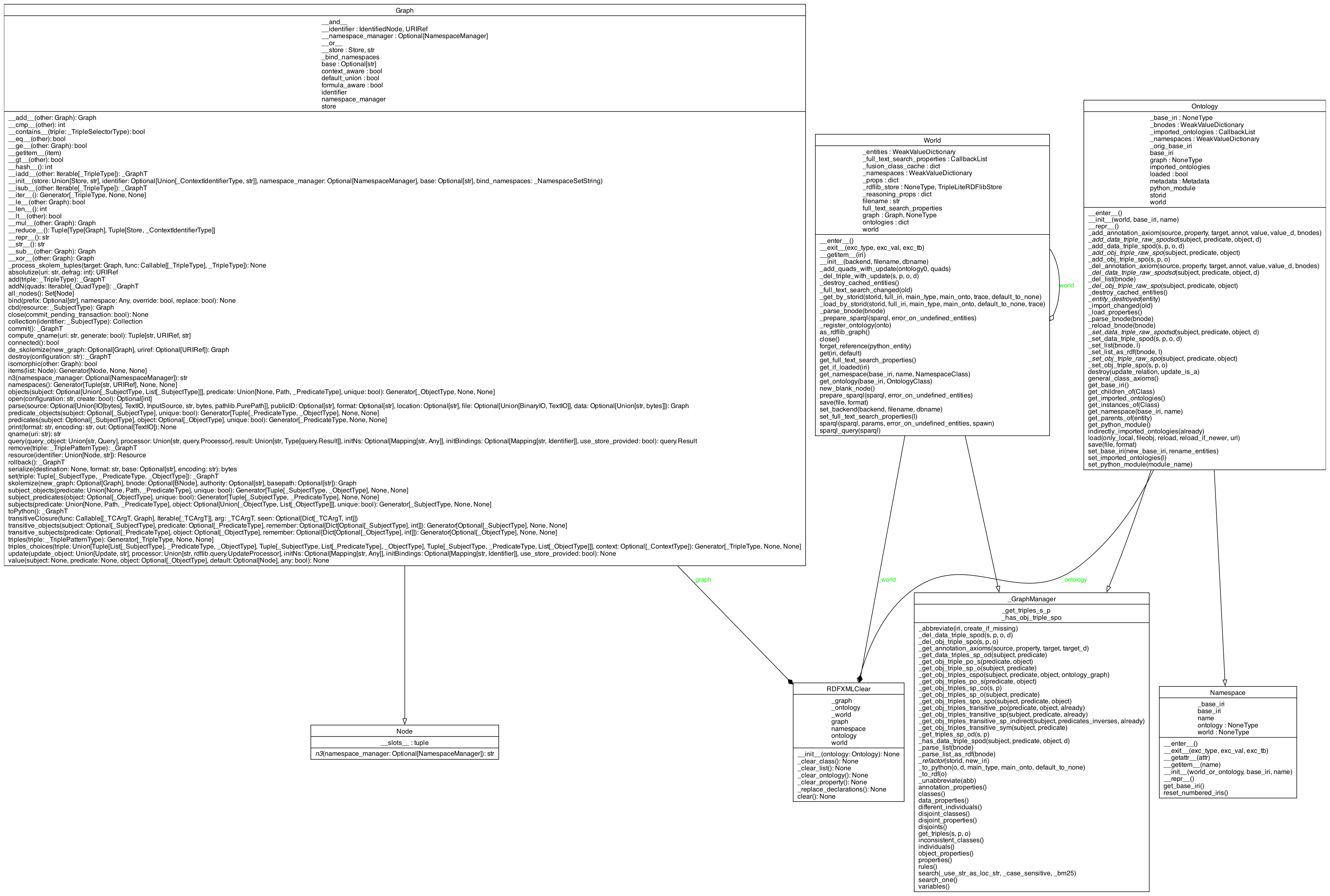
UML Class Diagram for RDFXMLClear
- class RDFXMLClear(ontology: owlready2.Ontology)[source]
This utility class is designed to sanitize and restructure an ontology by removing specific RDF/XML definitions from its underlying graph. It is initialized with an ontology instance, which provides access to the associated world and RDF graph data structures. The primary functionality is exposed through a method that systematically removes type declarations for classes, properties, and lists, effectively stripping away structural definitions. Additionally, the logic performs a normalization step that replaces certain property declarations, such as inverse functional or transitive properties, with more general types like object properties. This process modifies the ontology in place, allowing for the selective clearing of semantic metadata without deleting the entire data model.
- Parameters:
ontology (Ontology) – The target ontology instance from which RDF/XML data structures are removed.
world (World) – The World instance associated with the ontology, used for accessing and querying RDF triples and the underlying graph.
graph (Graph) – The RDFLib graph representation of the ontology’s world, providing a standard interface for querying and manipulating RDF triples.
- _clear_class() None[source]
This method systematically removes class definitions from the ontology by targeting specific RDF type assertions. It iterates over entities identified as OWL classes, RDFS datatypes, or OWL data ranges and deletes any triples that classify them as RDFS classes. Furthermore, it locates OWL restrictions and removes their declarations as either OWL classes or RDFS classes. This process directly modifies the ontology’s triple store, effectively stripping the class status from these entities while leaving other properties intact.
- _clear_list() None[source]
This method iterates through the ontology to identify resources explicitly typed as rdf:List and removes the triple asserting that type. It performs this removal only if the resource possesses the structural characteristics of a list, specifically checking for the existence of both rdf:first and rdf:rest properties. By deleting the type assertion, the method effectively undefines these resources as lists within the ontology without removing the underlying structural triples.
- _clear_ontology() None[source]
Removes all ontology declaration triples from the internal storage. It iterates through the RDF triples in the world to identify entries where the predicate is rdf:type and the object is owl:Ontology. Each matching triple is then deleted from the ontology’s internal store, effectively clearing the ontology’s declaration metadata.
- _clear_property() None[source]
Removes all property definitions from the ontology by targeting specific OWL property types. It iterates through the world to identify subjects declared as owl:ObjectProperty, owl:FunctionalProperty, owl:InverseFunctionalProperty, owl:TransitiveProperty, owl:DatatypeProperty, owl:AnnotationProperty, or owl:OntologyProperty. For each identified subject, the method locates and deletes the triple asserting that the subject is an instance of rdf:Property within the ontology. This process results in the permanent removal of these property definitions from the ontology’s data structure.
- _replace_declarations() None[source]
This method refines OWL property declarations within the ontology by replacing or adding specific type assertions based on the property’s characteristics. It iterates through triples in the world to identify properties declared as owl:OntologyProperty, owl:InverseFunctionalProperty, owl:TransitiveProperty, or owl:SymmetricProperty. For owl:OntologyProperty, the type is replaced with owl:AnnotationProperty, whereas for the inverse functional, transitive, and symmetric properties, owl:ObjectProperty is added as an additional type. Entities that do not possess an IRI attribute are skipped during this process. This operation results in direct modifications to the ontology’s triple store to align property declarations with the intended schema.
- clear() None[source]
Removes all structural definitions from the ontology by systematically deleting RDF triples associated with classes, lists, and properties. In addition to removal, this method transforms the remaining data by replacing certain OWL property declarations with more specific types. This operation directly mutates the underlying graph, resulting in the irreversible loss of the cleared definitions.
- _graph: rdflib.Graph
- _ontology: owlready2.Ontology
- _world: owlready2.World
- property graph: rdflib.Graph
Returns the RDF Graph object associated with this instance. This property provides direct access to the internal graph storage, allowing retrieval of the triples managed by the object. Since it returns a reference to the actual graph rather than a copy, any modifications made to the returned graph will directly affect the state of the RDFXMLClear instance.
- Returns:
The underlying graph object.
- Return type:
Graph
- property namespace: rdflib.Namespace
Returns the Namespace object associated with the base IRI of the ontology linked to this instance. This property retrieves the namespace by invoking the get_namespace method on the ontology attribute, using the ontology’s base_iri as the lookup key.
- Returns:
The Namespace object corresponding to the base IRI of the ontology.
- Return type:
Namespace
- property ontology: owlready2.Ontology
Returns the Ontology instance associated with the current object. This property getter exposes the internal _ontology attribute, providing access to the ontology data managed by the RDFXMLClear instance. Since it returns a direct reference to the stored object rather than a copy, any modifications made to the returned Ontology will directly affect the internal state of the parent object.
- Returns:
The Ontology object associated with this instance.
- Return type:
Ontology
- property world: owlready2.World
Retrieves the World instance associated with this RDFXMLClear object. This property acts as a getter for the internal _world attribute, providing access to the specific context or storage environment used by the RDF/XML parser or serializer. The method has no side effects and simply returns the reference to the stored World object.
- Returns:
The World instance associated with this object.
- Return type:
World
- get_abbreviation(iri: rdflib.URIRef) int[source]
Retrieves the integer identifier associated with a given IRI from the module’s global mapping. If the IRI has already been processed and exists within the _universal_iri_2_abbrev dictionary, the function returns the stored integer. Otherwise, it delegates to the _universal_abbrev function to generate a new abbreviation based on the string representation of the IRI, ensuring that all IRIs are consistently mapped to a compact integer format.
- Parameters:
iri (URIRef) – Internationalized Resource Identifier to look up in the universal mapping or generate a new abbreviation for.
- Returns:
The integer abbreviation associated with the IRI. If the IRI is not already mapped, a new abbreviation is generated and returned.
- Return type:
int
- is_named_individual(obj: object) bool[source]
Determines whether the provided object represents a named individual by verifying that it is an instance of the base Thing class while explicitly excluding instances of ThingClass. This distinction is necessary to differentiate between concrete entities and their abstract class definitions within the ontology structure. The check relies solely on type inspection and does not modify the input object or cause any side effects.
- Parameters:
obj (object) – The object to evaluate for named individual status.
- Returns:
True if the object is a named individual (an instance of Thing but not a ThingClass).
- Return type:
bool