pyowl2.utils.thing
A comprehensive wrapper for OWL class definitions that manages logical axioms, annotations, and hierarchical relationships within an ontology structure.
Description
The software provides a high-level abstraction for constructing and managing Web Ontology Language (OWL) class definitions by encapsulating an underlying class identity alongside its associated logical axioms and metadata. It serves as a central container that aggregates various types of constraints, including subclass relationships, equivalences, disjointness, and property restrictions, into a single cohesive object. By maintaining an internal registry of these statements, the implementation allows developers to programmatically build complex ontology structures without manually managing individual axiom objects.
Designed with a focus on flexibility and data integrity, the wrapper accepts both raw class expressions and other wrapper instances as inputs, normalizing them internally to ensure consistent handling. It enforces idempotency during state modification by verifying that a specific logical statement does not already exist before adding it to the collection, thereby preventing redundancy. The interface includes specialized properties for querying specific subsets of axioms, such as intersections, unions, or cardinality restrictions, enabling efficient inspection of the class’s logical definition.
Static factory methods are provided to instantiate the universal root class owl:Thing and the empty class owl:Nothing, aligning with standard OWL specifications. The architecture supports the attachment of annotations for metadata and facilitates the definition of complex class expressions through methods that handle set operations like unions and intersections. This approach simplifies the process of defining semantic constraints and hierarchical relationships, making it easier to model domain knowledge within an ontology.
Classes
This class acts as a comprehensive container for an OWL (Web Ontology Language) class definition, combining the core class identity with its logical axioms and metadata annotations. It provides a fluent interface for constructing complex ontology structures, allowing users to define subclass relationships, equivalences, disjointness, and various property restrictions such as cardinality and value constraints. By managing an internal list of axioms, it ensures that duplicate logical statements are not added, while offering properties to easily retrieve specific subsets of axioms, such as intersections, unions, or class assertions. The class is designed to accept both raw class expressions and other full class instances as arguments, facilitating flexible ontology modeling. |
Module Contents
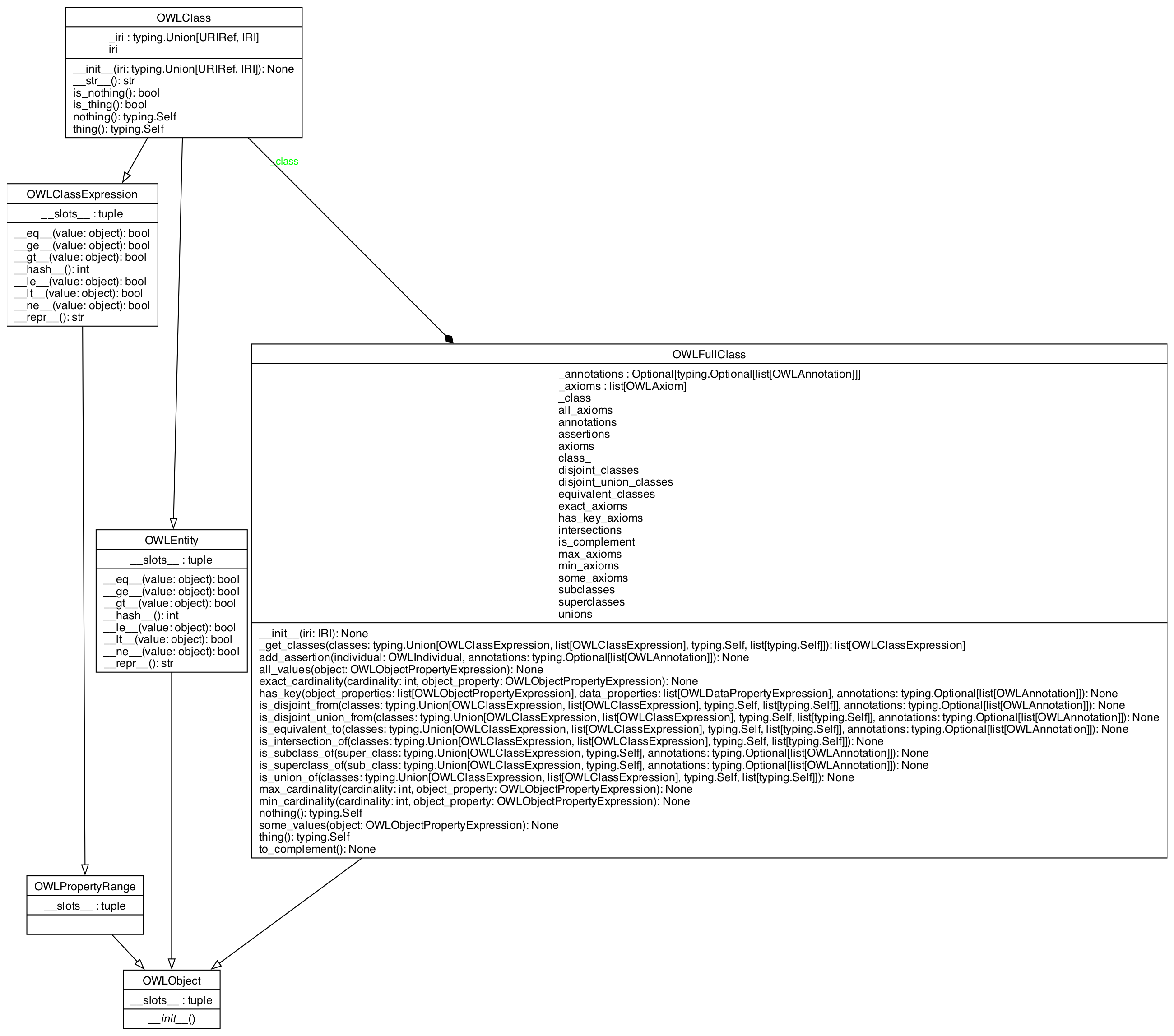
UML Class Diagram for OWLFullClass
- class OWLFullClass(iri: pyowl2.base.iri.IRI)[source]
Bases:
pyowl2.abstracts.object.OWLObject
This class acts as a comprehensive container for an OWL (Web Ontology Language) class definition, combining the core class identity with its logical axioms and metadata annotations. It provides a fluent interface for constructing complex ontology structures, allowing users to define subclass relationships, equivalences, disjointness, and various property restrictions such as cardinality and value constraints. By managing an internal list of axioms, it ensures that duplicate logical statements are not added, while offering properties to easily retrieve specific subsets of axioms, such as intersections, unions, or class assertions. The class is designed to accept both raw class expressions and other full class instances as arguments, facilitating flexible ontology modeling.
- Parameters:
class (OWLClass) – The underlying OWLClass instance representing the core definition of the class, identified by its IRI, which serves as the subject for the axioms and annotations managed by this wrapper.
axioms (list[OWLAxiom]) – A list of axioms defining the logical relationships and constraints for the class, including subclass relationships, equivalence, disjointness, and cardinality restrictions.
annotations (Optional[list[OWLAnnotation]]) – Stores the optional list of annotations associated with the class, providing metadata such as labels or comments.
- Raises:
TypeError – Raised when the input provided to methods defining class relationships (such as equivalence, disjointness, or unions) is not an OWLClassExpression, an OWLFullClass, or a list of these types.
- _get_classes(
- classes: pyowl2.abstracts.class_expression.OWLClassExpression | list[pyowl2.abstracts.class_expression.OWLClassExpression] | Self | list[Self],
Normalizes input class representations into a standardized list of OWLClassExpression objects. The method accepts either a single instance or a list of instances, supporting both OWLClassExpression objects and the current class type (OWLFullClass). When an OWLFullClass is encountered, its underlying class expression is extracted via the class_ attribute. The input list must be homogeneous; mixing types or providing invalid arguments results in a TypeError. This function performs no side effects on the instance state.
- Parameters:
classes (Union[OWLClassExpression, list[OWLClassExpression], Self, list[Self]]) – The class or classes to be converted into a list of OWLClassExpression objects. Can be a single instance or a list of OWLClassExpression or OWLFullClass instances.
- Raises:
TypeError – Raised if the classes argument is not an OWLClassExpression, an OWLFullClass, or a list exclusively containing one of these types.
- Returns:
A list of OWLClassExpression objects normalized from the input, handling single items, lists, and unwrapping OWLFullClass instances.
- Return type:
list[OWLClassExpression]
- add_assertion(
- individual: pyowl2.abstracts.individual.OWLIndividual,
- annotations: list[pyowl2.base.annotation.OWLAnnotation] | None = None,
Creates and stores a class assertion axiom stating that the specified individual is an instance of the class represented by this object. The method accepts an optional list of annotations to attach metadata to the assertion. It ensures idempotency by checking the existing axioms; if an identical assertion is already present, the method returns without making changes. Otherwise, the new assertion is appended to the internal list of axioms.
- Parameters:
individual (OWLIndividual) – The entity to be asserted as an instance of the class represented by this object.
annotations (Optional[list[OWLAnnotation]]) – Optional list of annotation objects to attach to the class assertion, providing additional metadata or context.
- all_values(object: pyowl2.abstracts.object_property_expression.OWLObjectPropertyExpression) None[source]
Constructs an OWL restriction asserting that all values associated with the provided object property must be instances of the current class. This method creates an OWLObjectAllValuesFrom element, which defines the current class as the universal range for the given property, and adds it to the internal collection of axioms. The operation is idempotent; if the specific restriction is already present in the axioms list, it will not be added again.
- Parameters:
object (OWLObjectPropertyExpression) – The object property expression defining the relationship for which the universal restriction applies.
- exact_cardinality(
- cardinality: int,
- object_property: pyowl2.abstracts.object_property_expression.OWLObjectPropertyExpression,
Adds an exact cardinality restriction to the class, asserting that instances must have exactly the specified number of relationships via the given object property. The method creates an OWLObjectExactCardinality axiom and appends it to the internal list of axioms, checking first to ensure that an identical axiom is not already present. This prevents duplicate constraints and enforces a specific count of object property assertions for any individual classified under this class.
- Parameters:
cardinality (int) – The exact number of relationships that instances of the class must have via the specified object property.
object_property (OWLObjectPropertyExpression) – The object property expression to which the exact cardinality restriction applies.
- has_key(
- object_properties: list[pyowl2.abstracts.object_property_expression.OWLObjectPropertyExpression],
- data_properties: list[pyowl2.abstracts.data_property_expression.OWLDataPropertyExpression],
- annotations: list[pyowl2.base.annotation.OWLAnnotation] | None = None,
This method defines a key for the current OWL class by asserting that a specific combination of object and data properties uniquely identifies instances of the class. It constructs an OWLHasKey axiom using the provided property lists and optional annotations, appending it to the class’s internal collection of axioms. The operation is idempotent; if an identical axiom already exists within the axioms, the method returns without modification to avoid duplicates.
- Parameters:
object_properties (list[OWLObjectPropertyExpression]) – Object properties that constitute part of the key, uniquely identifying instances of this class based on relationships to other individuals.
data_properties (list[OWLDataPropertyExpression]) – A list of data properties that uniquely identify instances of this class based on their associated literal values.
annotations (Optional[list[OWLAnnotation]]) – Optional metadata to attach to the axiom, providing additional context such as source or confidence.
- is_disjoint_from(
- classes: pyowl2.abstracts.class_expression.OWLClassExpression | list[pyowl2.abstracts.class_expression.OWLClassExpression] | Self | list[Self],
- annotations: list[pyowl2.base.annotation.OWLAnnotation] | None = None,
Asserts that the current class is disjoint from the specified class or classes, meaning they share no common instances. This method constructs a disjointness axiom using the current class and the provided class expressions, which can be supplied as individual objects or lists. If the generated axiom already exists within the internal collection of axioms, it is not added again, ensuring idempotency. Optionally, a list of annotations can be provided to attach metadata to the axiom. The primary side effect of this operation is the modification of the internal axioms list by appending the new disjointness axiom if it is unique.
- Parameters:
classes (Union[OWLClassExpression, list[OWLClassExpression], Self, list[Self]]) – The class or classes to be asserted as disjoint from the current class. Can be a single OWLClassExpression or OWLFullClass, or a list of such objects.
annotations (Optional[list[OWLAnnotation]]) – Optional list of annotations to include with the disjointness axiom, providing additional metadata or context.
- is_disjoint_union_from(
- classes: pyowl2.abstracts.class_expression.OWLClassExpression | list[pyowl2.abstracts.class_expression.OWLClassExpression] | Self | list[Self],
- annotations: list[pyowl2.base.annotation.OWLAnnotation] | None = None,
This method asserts that the current class is a disjoint union of the specified class expressions, meaning the class is exactly equivalent to the union of the provided classes while ensuring those classes are mutually exclusive (pairwise disjoint). It accepts a single class expression or a list of expressions, and optionally associates a list of annotations with the axiom to provide metadata. The method constructs the corresponding OWLDisjointUnion axiom and appends it to the internal list of axioms, but only if an identical axiom does not already exist, thereby preventing redundancy.
- Parameters:
classes (Union[OWLClassExpression, list[OWLClassExpression], Self, list[Self]]) – The class expressions or class instances that constitute the disjoint union, representing the mutually exclusive and exhaustive components of the current class.
annotations (Optional[list[OWLAnnotation]]) – An optional list of annotations to attach to the disjoint union axiom, providing additional metadata or context.
- is_equivalent_to(
- classes: pyowl2.abstracts.class_expression.OWLClassExpression | list[pyowl2.abstracts.class_expression.OWLClassExpression] | Self | list[Self],
- annotations: list[pyowl2.base.annotation.OWLAnnotation] | None = None,
Asserts that the current class is equivalent to the specified class or classes by adding an equivalence axiom to the ontology. If multiple classes are provided, the method asserts that the current class is equivalent to the intersection of those classes. Optional annotations can be included to attach metadata to the axiom. The method ensures idempotency by checking the existing axioms; if the specific equivalence axiom is already present, it is not added again.
- Parameters:
classes (Union[OWLClassExpression, list[OWLClassExpression], Self, list[Self]]) – The class expression(s) to which the current class is asserted as equivalent. If a list is provided, the current class is asserted as equivalent to the intersection of the specified classes.
annotations (Optional[list[OWLAnnotation]]) – Optional list of annotations to include with the equivalence axiom, providing additional metadata or context.
- is_intersection_of(
- classes: pyowl2.abstracts.class_expression.OWLClassExpression | list[pyowl2.abstracts.class_expression.OWLClassExpression] | Self | list[Self],
This method asserts that the current class is equivalent to the intersection of the provided class expressions. It accepts a single class expression or a list of expressions, which can be standard OWL class expressions or other OWLFullClass instances, to define the necessary and sufficient conditions for class membership. The method constructs an intersection axiom representing this relationship and adds it to the class’s list of axioms. To ensure data integrity and avoid redundancy, it checks if the specific intersection axiom already exists; if it is present, the method performs no action, otherwise, it appends the new axiom to the internal collection.
- Parameters:
classes (Union[OWLClassExpression, list[OWLClassExpression], Self, list[Self]]) – One or more class expressions to be combined with the current class to form an intersection.
- is_subclass_of(
- super_class: pyowl2.abstracts.class_expression.OWLClassExpression | Self,
- annotations: list[pyowl2.base.annotation.OWLAnnotation] | None = None,
Asserts a subclass relationship between the current class and the specified super_class by adding a corresponding axiom to the internal collection. The method accepts either a raw OWLClassExpression or another OWLFullClass instance, extracting the underlying class expression as needed. Optional annotations can be provided to attach metadata to the relationship. This operation modifies the state of the object by appending the new axiom, but it is idempotent; if the specific subclass relationship already exists within the axioms, the method returns without making changes to prevent duplicates.
- Parameters:
super_class (Union[OWLClassExpression, Self]) – The class expression or class instance representing the superclass to which this class is asserted as a subclass.
annotations (Optional[list[OWLAnnotation]])
- is_superclass_of(
- sub_class: pyowl2.abstracts.class_expression.OWLClassExpression | Self,
- annotations: list[pyowl2.base.annotation.OWLAnnotation] | None = None,
Asserts that the current class is a superclass of the specified subclass by creating and registering a corresponding OWLSubClassOf axiom. The subclass argument can be either a direct class expression or another OWLFullClass instance, from which the underlying class expression is extracted. If the specific relationship is already present in the object’s axioms, the operation is skipped to prevent duplication. Optional annotations may be provided to attach metadata, such as provenance or confidence, to the relationship.
- Parameters:
sub_class (Union[OWLClassExpression, Self]) – The class expression or class instance to be asserted as a subclass of the current class.
annotations (Optional[list[OWLAnnotation]]) – Optional list of annotations to attach to the subclass axiom, providing additional metadata or context for the relationship.
- is_union_of(
- classes: pyowl2.abstracts.class_expression.OWLClassExpression | list[pyowl2.abstracts.class_expression.OWLClassExpression] | Self | list[Self],
Asserts that the current class is equivalent to the union of the provided class expressions. The method accepts a single class or a list of classes, constructing an OWLObjectUnionOf instance that represents this relationship. It checks for existing axioms to prevent duplication; if the specific union expression is already present, the method takes no action. Otherwise, the new union expression is appended to the internal list of axioms, effectively defining the class as the union of the specified components.
- Parameters:
classes (Union[OWLClassExpression, list[OWLClassExpression], Self, list[Self]]) – The class or classes that form the union with the current class. Can be a single class expression or a list of class expressions.
- max_cardinality(
- cardinality: int,
- object_property: pyowl2.abstracts.object_property_expression.OWLObjectPropertyExpression,
Asserts a maximum cardinality restriction on the current class, indicating that any instance of this class can participate in at most the specified number of relationships defined by the given object property. This method creates an OWLObjectMaxCardinality axiom and adds it to the internal collection of axioms associated with the class. It ensures idempotency by verifying that an identical axiom does not already exist before performing the addition, thereby preventing duplicate entries.
- Parameters:
cardinality (int) – The maximum number of distinct individuals that instances of this class can be related to via the specified object property.
object_property (OWLObjectPropertyExpression) – The object property expression representing the relationship to which the maximum cardinality restriction applies.
- min_cardinality(
- cardinality: int,
- object_property: pyowl2.abstracts.object_property_expression.OWLObjectPropertyExpression,
Asserts a minimum cardinality restriction on the current class for a specified object property, requiring that instances of the class have at least the defined number of relationships via that property. This method constructs the corresponding axiom and appends it to the internal collection of axioms, but only if an identical axiom does not already exist, thereby preventing redundancy. The operation modifies the state of the class by updating its axioms list but does not return a value.
- Parameters:
cardinality (int) – The minimum number of relationships instances of the class must have via the specified object property.
object_property (OWLObjectPropertyExpression) – The object property expression to which the minimum cardinality restriction applies.
- static nothing() Self[source]
This static method serves as a factory for creating an OWLFullClass instance that represents the OWL Nothing class, which is the empty class containing no individuals. It initializes the instance using the standard IRI http://www.w3.org/2002/07/owl#Nothing obtained from the IRI utility. As the most specific class in the OWL hierarchy, Nothing is implicitly a subclass of every other class, and this method provides a convenient way to reference it without manually constructing the IRI. The function has no side effects and returns a new instance on every call.
- Returns:
An OWLFullClass instance representing the OWL “Nothing” class, which is the empty class containing no individuals.
- Return type:
Self
- some_values(object: pyowl2.abstracts.object_property_expression.OWLObjectPropertyExpression) None[source]
Adds an existential restriction to the class’s axioms, asserting that instances of the class must have at least one value for the specified object property. The restriction is constructed using the provided property and the class itself, implying a relationship where the value is an instance of the current class. This method ensures idempotency by verifying that the restriction does not already exist in the axioms list before adding it; if it is found, the method returns without changes. Otherwise, the new restriction is appended to the axioms.
- Parameters:
object (OWLObjectPropertyExpression) – The object property expression used to assert that the class has some values from this property.
- static thing() Self[source]
This static method acts as a factory for the root class of the OWL hierarchy, returning an OWLFullClass instance that represents the owl:Thing entity. As the most general class in the Web Ontology Language, owl:Thing implicitly includes all individuals and serves as the ultimate superclass for all other defined classes. The implementation relies on the standard IRI associated with owl:Thing to instantiate the object, ensuring that the returned class aligns with the W3C OWL specification. Since this method takes no arguments and performs no state mutations, it has no side effects and simply provides a semantic reference to the universal class.
- Returns:
An instance representing the OWL “Thing” class, the most general class in the ontology that encompasses all individuals.
- Return type:
Self
- to_complement() None[source]
Creates a representation of the logical complement of the current class and adds it to the internal list of axioms. The method verifies that this specific complement axiom is not already present in the collection to avoid redundancy. This process modifies the object’s internal state and does not return a value.
- _annotations: list[pyowl2.base.annotation.OWLAnnotation] | None = None
- _axioms: list[pyowl2.abstracts.axiom.OWLAxiom] = []
- _class: pyowl2.base.owl_class.OWLClass
- property all_axioms: list[pyowl2.class_expression.object_all_values_from.OWLObjectAllValuesFrom]
Retrieves a filtered list of axioms representing universal restrictions (specifically OWLObjectAllValuesFrom) that are associated with this class. This property iterates through the general collection of axioms and selects only those that define constraints requiring all values of a given object property to belong to a specified filler class. The operation is read-only and returns an empty list if no such axioms are present.
- Returns:
A list of universal restriction axioms (OWLObjectAllValuesFrom) associated with this class, indicating that all values of a specific property for instances of this class must belong to a specified class.
- Return type:
list[OWLObjectAllValuesFrom]
- property annotations: list[pyowl2.base.annotation.OWLAnnotation] | None
Updates the annotations associated with the OWL class by replacing the existing collection with the provided value. The method accepts a list of OWLAnnotation objects or None, allowing the annotations to be explicitly set or cleared. This operation directly modifies the internal state of the instance to reflect the new metadata.
- Parameters:
value (Optional[list[OWLAnnotation]]) – A list of OWL annotations to assign to the object, or None.
- property assertions: list[pyowl2.axioms.assertion.class_assertion.OWLClassAssertion]
Retrieves a list of class assertion axioms that explicitly declare individuals as instances of this class. By filtering the internal collection of axioms, this method identifies all statements where an individual is asserted to belong to the current class expression. The returned list contains OWLClassAssertion objects, which encapsulate the specific individuals along with any annotations attached to those assertions. This operation is read-only and returns a new list, meaning modifications to the result will not affect the underlying ontology structure, and it will return an empty list if no such assertions exist.
- Returns:
A list of OWLClassAssertion axioms that assert individuals as instances of this class.
- Return type:
list[OWLClassAssertion]
- property axioms: list[pyowl2.abstracts.axiom.OWLAxiom]
Retrieves the list of axioms associated with this OWL class instance. This property provides direct access to the internal collection of OWLAxiom objects stored within the class, representing the logical statements that define or describe it. The method returns the list reference without performing any computation or side effects, though modifications to the returned list may alter the internal state of the object.
- Returns:
A list of axioms associated with this object.
- Return type:
list[OWLAxiom]
- property class_: pyowl2.base.owl_class.OWLClass
Retrieves the OWLClass object that this OWLFullClass instance represents or wraps. As a property, it provides read-only access to the internal _class attribute, ensuring that the underlying ontology class can be accessed without triggering side effects or state changes.
- Returns:
The OWL class associated with this instance.
- Return type:
- property disjoint_classes: list[pyowl2.axioms.class_axiom.disjoint_classes.OWLDisjointClasses]
This property retrieves a list of axioms that explicitly declare this class to be disjoint with other classes within the ontology. It filters the class’s associated axioms to return only those of type OWLDisjointClasses. Each axiom in the resulting list enforces the semantic constraint that the class extensions are mutually exclusive, meaning no individual can be an instance of both this class and the classes specified in the axiom.
- Returns:
A list of axioms asserting that this class is disjoint with other classes, meaning they have no common instances.
- Return type:
list[OWLDisjointClasses]
- property disjoint_union_classes: list[pyowl2.axioms.class_axiom.disjoint_union.OWLDisjointUnion]
Retrieves a list of OWLDisjointUnion axioms that define this class as a disjoint union of other classes within the ontology. This property filters the axioms associated with the class to identify those asserting that the class is equivalent to the union of a set of distinct, non-overlapping classes. If the class is not involved in any disjoint union axioms, an empty list is returned. The operation is read-only and does not modify the underlying ontology structure.
- Returns:
A list of OWLDisjointUnion axioms associated with this class.
- Return type:
list[OWLDisjointUnion]
- property equivalent_classes: list[pyowl2.axioms.class_axiom.equivalent_classes.OWLEquivalentClasses]
Retrieves a list of axioms asserting that this class is equivalent to other class expressions within the ontology. This property filters the class’s associated axioms to return only those of type OWLEquivalentClasses, which indicate that the current class and the referenced classes share exactly the same set of instances. The result is a list that may be empty if no equivalence relationships are defined for this class.
- Returns:
A list of axioms asserting that this class is equivalent to other class expressions.
- Return type:
list[OWLEquivalentClasses]
- property exact_axioms: list[pyowl2.class_expression.object_exact_cardinality.OWLObjectExactCardinality]
Retrieves a filtered list of axioms that impose exact cardinality restrictions on the class. This property iterates through the class’s associated axioms and selects only those that are instances of OWLObjectExactCardinality, which define constraints requiring instances of the class to have a specific, precise number of relationships via a given object property. The operation returns a new list, ensuring that modifications to the result do not affect the internal state of the class, and yields an empty list if no matching restrictions are found.
- Returns:
A list of exact cardinality axioms involving this class.
- Return type:
- property has_key_axioms: list[pyowl2.axioms.has_key.OWLHasKey]
Retrieves a collection of axioms that define unique identifiers for instances of this class. Each returned axiom specifies a set of properties that, when combined, distinguish individual instances of the class within the ontology. This property filters the general list of axioms associated with the class to isolate those of type OWLHasKey, returning an empty list if no such constraints are defined. The operation is read-only and does not alter the internal state of the object.
- Returns:
A list of OWLHasKey axioms associated with this class, specifying the properties that uniquely identify its instances.
- Return type:
list[OWLHasKey]
- property intersections: list[pyowl2.class_expression.object_intersection_of.OWLObjectIntersectionOf]
Retrieves a list of axioms that define this class as the logical intersection of multiple class expressions. This property filters the class’s internal collection of axioms, returning only those instances of OWLObjectIntersectionOf. The operation is read-only and returns a new list; if no intersection axioms are associated with the class, an empty list is returned.
- Returns:
A list of axioms representing the intersection of class expressions associated with this class, indicating the conditions an individual must satisfy to be an instance.
- Return type:
list[OWLObjectIntersectionOf]
- property is_complement: bool
Indicates whether this class is defined as a complement of another class by examining its associated axioms. The property returns True if at least one of the axioms is an instance of OWLObjectComplementOf, signifying that the class represents a logical negation of another class. If no such complement axioms are present, it returns False.
- Returns:
True if the class is defined as a complement of another class, False otherwise.
- Return type:
bool
- property max_axioms: list[pyowl2.class_expression.object_max_cardinality.OWLObjectMaxCardinality]
This property retrieves a list of OWLObjectMaxCardinality axioms associated with the current OWLFullClass. It filters the class’s general collection of axioms to isolate those that define maximum cardinality restrictions, which specify the upper limit on the number of object property relationships an instance of this class may possess. The operation does not modify the internal state of the class and returns a new list; if no matching axioms are found, an empty list is returned.
- Returns:
A list of axioms defining the maximum cardinality restrictions applicable to this class.
- Return type:
list[OWLObjectMaxCardinality]
- property min_axioms: list[pyowl2.class_expression.object_min_cardinality.OWLObjectMinCardinality]
This property retrieves a collection of minimum cardinality restrictions defined for the current OWL class by filtering the class’s complete set of axioms. It specifically isolates instances of OWLObjectMinCardinality, which assert that members of this class must participate in at least a specified number of relationships via a particular object property. The method returns a new list containing these specific axioms; if no minimum cardinality restrictions are present, an empty list is returned. Because this is a computed property, it has no side effects on the object’s state, and the returned list is a distinct copy from the internal storage.
- Returns:
A list of minimum cardinality axioms involving this class.
- Return type:
list[OWLObjectMinCardinality]
- property some_axioms: list[pyowl2.class_expression.object_some_values_from.OWLObjectSomeValuesFrom]
Filters the class’s collection of axioms to return only those representing existential restrictions, specifically instances of OWLObjectSomeValuesFrom. Each returned axiom indicates that some instances of this class are required to participate in a specific object property relationship. This property is read-only and returns a new list instance; if no such restrictions are defined within the class’s axioms, an empty list is returned.
- Returns:
A list of existential restriction axioms (ObjectSomeValuesFrom) associated with this class, indicating properties that some instances of the class must satisfy.
- Return type:
list[OWLObjectSomeValuesFrom]
- property subclasses: list[pyowl2.axioms.class_axiom.sub_class_of.OWLSubClassOf]
This property retrieves a list of OWLSubClassOf axioms that define this class as the superclass. It filters the internal collection of axioms associated with this entity to identify relationships where another class is explicitly stated to be a subclass of the current instance. Each returned axiom represents a direct hierarchical link, indicating that all individuals belonging to the subclass are also instances of this class. If no such axioms exist, an empty list is returned.
- Returns:
A list of axioms asserting this class as the superclass.
- Return type:
list[OWLSubClassOf]
- property superclasses: list[pyowl2.axioms.class_axiom.sub_class_of.OWLSubClassOf]
Retrieves the axioms that define the superclasses of this class by filtering the internal collection of axioms. Specifically, it returns a list of OWLSubClassOf axioms where the subclass expression matches the current class, thereby identifying the classes that this class is a subclass of. This property is read-only and returns a new list, meaning modifications to the returned list will not affect the object’s internal state. If no matching axioms are found, an empty list is returned.
- Returns:
A list of OWLSubClassOf axioms asserting that this class is a subclass of another class.
- Return type:
list[OWLSubClassOf]
- property unions: list[pyowl2.class_expression.object_one_of.OWLObjectOneOf]
This property retrieves a list of axioms associated with the current class that are instances of OWLObjectOneOf. It filters the class’s internal collection of axioms to isolate those representing union constructs, as implied by the property name. The returned list is a new list instance, ensuring that modifications to the collection will not affect the underlying state of the class. If no axioms of this specific type are present, the property returns an empty list.
- Returns:
A list of OWLObjectOneOf axioms associated with this object.
- Return type:
list[OWLObjectOneOf]